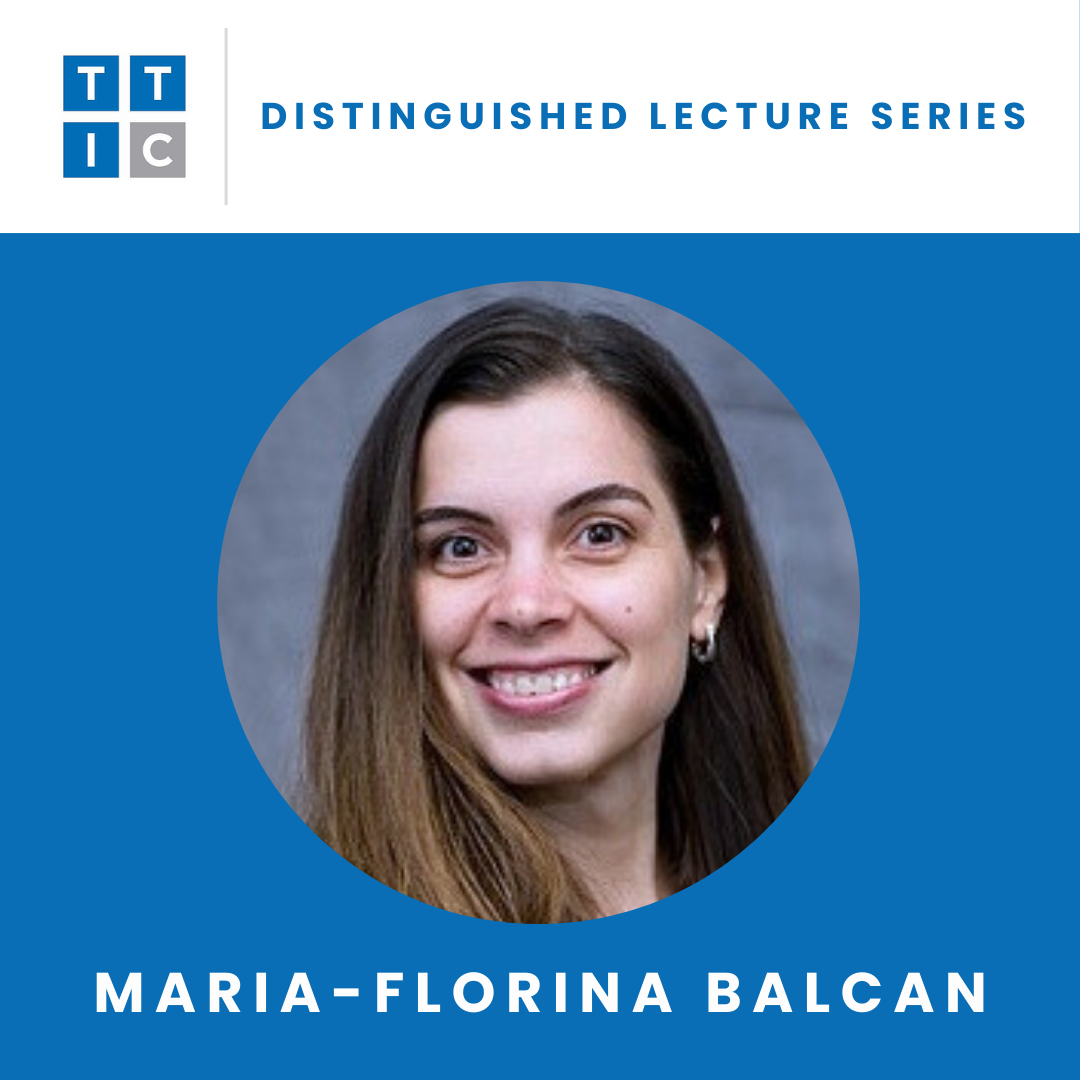
Monday, March 23rd, 2026 at 11:00am

Maria-Florina Balcan

Cadence Design Systems Professor of Computer Science (MLD and CSD), Carnegie Mellon University

Host: Avrim Blum

Streaming here.


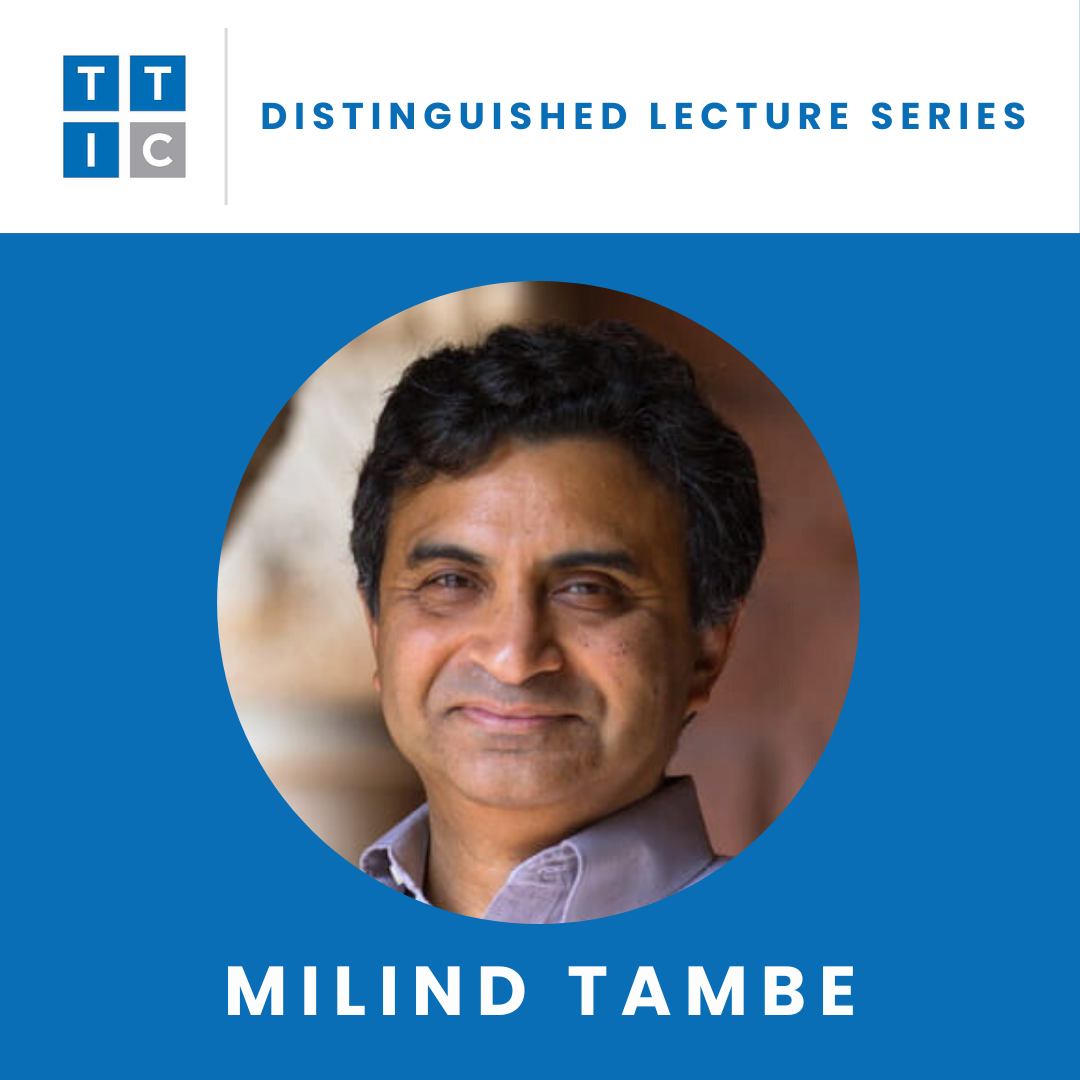
Thursday, February 26th, 2026 at 11:00am

Milind Tambe

Gordon McKay Professor of Computer Science,Harvard University
Principal Scientist and Director for “AI for Social Good”, Google Research

Generative AI for Global Social Impact: Towards Solving the Deployment Bottleneck

Abstract: My team’s work on AI for Social Impact (AI4SI) has spanned two decades, focusing on optimizing limited resources in critical areas like public health, conservation, and public safety. I will present field results from India, where the deployment of restless and collaborative multi-armed bandit (RMAB) algorithms achieved significant improvements in the world’s two largest mobile maternal health programs. I will also highlight ongoing work on network-based HIV prevention in South Africa, modeled as a branching bandit problem. These projects, along with other initiatives across Africa and Asia, expose a critical “deployment bottleneck” that spans the entire machine learning pipeline. This bottleneck consists of three key hurdles: the observational scarcity gap (data), the policy synthesis gap (learning and modeling), and the human-AI alignment gap (deployment).

This talk investigates how Generative AI can accelerate the AI4SI deployment cycle through the strategic use of LLM Agents and diffusion models. I will demonstrate how LLM Agents address the alignment gap by integrating expert guidance into algorithmic planning, ensuring resource optimization strategies reflect real-world priorities. Furthermore, I will show how diffusion models mitigate the scarcity and synthesis gaps by generating synthetic social networks and facilitating Transfer RL to utilize data across domains. I will conclude by discussing this path toward a more scalable, human-aligned future for AI for Social Impact.

Bio: Milind Tambe is the Gordon McKay Professor of Computer Science at Harvard University; concurrently, he is Principal Scientist and Director for “AI for Social Good” at Google Research. Prof. Tambe and his team have developed innovative AI and multi-agent reasoning systems that have been successfully deployed to deliver real-world impact in public health (e.g., maternal and child health), public safety, and wildlife conservation.

He is the recipient of the AAAI Award for Artificial Intelligence for the Benefit of Humanity, the AAAI Feigenbaum Prize, the IJCAI John McCarthy Award, the AAAI Robert S. Engelmore Memorial Lecture Award, and the AAMAS ACM/SIGAI Autonomous Agents Research Award. He is a fellow of AAAI and ACM. His contributions in Operations Research and public safety have also been recognized with the INFORMS Wagner Prize for excellence in Operations Research practice, Military Operations Research Society Rist Prize, the Columbus Fellowship Foundation Homeland security award, and commendations and certificates of appreciation from the US Coast Guard, the Federal Air Marshals Service, and airport police at the city of Los Angeles.

Host: Avrim Blum

Streaming here.


Wednesday, November 5th, 2025 at 11:00am

Aaron Hertzmann

Principal Scientist, Adobe Research

Can Computers Create Art?

Abstract: Can AI algorithms make art, and be considered artists? Within the past decade, the growth of new neural network algorithms has enabled exciting new art forms with considerable public interest. These tools raise recurring questions about their status as creators and their effect on the arts. In this talk, I will discuss how these developments parallel the development of previous artistic technologies, like oil paint, photography, and traditional computer graphics, with many useful analogies between past and current developments. I argue that art is a social phenomenon, that “AI” algorithms will not have human-level intelligence in the foreseeable future, and thus it is extremely unlikely that we will ever consider algorithms to be artists.

However, they, like past art technologies, will change the way we make and understand art.

Bio: Aaron Hertzmann is a Principal Scientist at Adobe Research, and Affiliate Faculty at the University of Washington. He received a bachelor’s degree in Computer Science and Art at Rice University and a PhD degree in Computer Science from New York University. He was previously a Professor of Computer Science at the University of Toronto for ten years. He has published over 125 papers in computer graphics, AI, and the science of art. He is an IEEE Fellow, an ACM Fellow, and winner of the 2024 SIGGRAPH Computer Graphics Achievement Award.

Host: Shiry Ginosar

Streaming here.


Monday, May 19th, 2025 at 11:00am

Eran Segal

Professor, Weizmann Institute of Science

Personalized medicine based on deep human phenotyping

Abstract: Recent technological advances allow large cohorts of human individuals to be profiled, presenting many challenges and opportunities. I will present The Human Phenotype Project, a large-scale (>25,000 participants) deep-p​henotype prospective longitudinal cohort and biobank that we established, aimed at identifying novel molecular markers with diagnostic, prognostic and therapeutic value, and at developing prediction models for disease onset and progression. Our deep profiling includes medical history, lifestyle and nutritional habits, vital signs, anthropometrics, blood tests, continuous glucose and sleep monitoring, and molecular profiling of the transcriptome, genetics, gut and oral microbiome, metabolome and immune system. Our analyses of this data provide novel insights into potential drivers of obesity, diabetes, and heart disease, and identify hundreds of novel markers at the microbiome, metabolite, and immune system level. Foundation AI models that we developed provide novel representations of the diverse modalities that we measured on the cohort and achieve state-of-the-art performance in predicting future onset of disease and trajectories of disease risk factors. Overall, our predictive models can be translated into personalized disease prevention and treatment plans, and to the development of new therapeutic modalities based on metabolites and the microbiome.

Bio: Eran Segal is a computational biologist professor at the Weizmann Institute of Science. He leads a multi-disciplinary team of computational biologists and experimental scientists working in the area of Computational and Systems biology. Focuses on Nutrition, Genetics, Microbiome, and Gene Regulation and their effect on health and disease. His lab aims to develop personalized nutrition and personalized medicine using machine learning, computational biology, probabilistic modeling, and analysis of heterogeneous high-throughput genomic and clinical data.

Host: Nati Srebro

Recording here.


Monday, May 12th, 2025 at 11:30am

Richard S. Zemel

Professor, Columbia University

Improving the Diversity and Evaluation of Large Models

Abstract: Given their increasing ubiquity it is of the utmost importance to ensure that AI systems can represent a diverse set of human values and perspectives. Meanwhile, progress on this type of control of Large Language Models (LLMs) has been hampered by a fundamental underlying problem in generative models: the difficulty of evaluating their behavior. With their enormous range of inputs and responses and the wide variety of intended applications and dimensions along which to judge the responses, evaluation is extremely challenging. I will describe two strands of research to help address these needs.

The first aims to develop approaches that permit reliable and fine-grained control over LLM generations, which allow them to be steered towards a broad set of viewpoints. The second aims to rigorously combine model-generated labels of an LLM’s responses with a small pool of ground-truth labels, to allow estimates of different aspects of the range of responses. I will describe quantitative and qualitative evaluations of these methods on a number of benchmark datasets, spanning public opinion data, educational tutoring, economic disparities, and LLM toxicity and summarization quality.

Bio: Richard Zemel is the Trianthe Dakolias Professor of Engineering and Applied Science in the Computer Science Department at Columbia University. He is the Director of the NSF AI Institute for Artificial and Natural Intelligence (ARNI). He was the Co-Founder and inaugural Research Director of the Vector Institute for Artificial Intelligence. He is a Canadian Institute for Advanced Research AI Chair, an Amazon Scholar, and is on the Advisory Board of the Neural Information Processing Society. His research contributions include foundational work on systems that learn useful representations of data with little or no supervision; graph-based machine learning; and algorithms for fair and robust machine learning.

Host: Avrim Blum

Recording here.


Monday, May 12th, 2025 at 10:30am

Toniann Pitassi

Professor, Columbia University

Strong Cell Probe Lower Bounds via Local PRGs

Abstract: In this talk, we observe a tight connection between three topics: $NC^0$ cryptography, $NC^0$ range avoidance, and static data structure lower bounds. Using this connection, we leverage techniques from the cryptanalysis of $NC^0$ PRGs to prove state-of-the-art results in the latter two subjects. Our main result is a quadratic improvement (for space as a function of time) to the best cell probe lower bounds, breaking a longstanding barrier. We then utilize our explicit cell probe lower bounds to obtain the best known unconditional algorithms for $NC^0$ range avoidance: we can solve any instance with stretch n ↦ m in polynomial time once $m >> n^2$ and with the aid of an NP oracle we can solve any instance with $m >> n^{t/2}$ when t is odd. Finally, using our main correspondence we establish novel barrier results for obtaining significant improvements to our cell probe lower bounds.

This is joint work with Oliver Korten and Russell Impagliazzo.

Bio: Toniann Pitassi was the Bell Canada Chair in Information Systems, in the Department of Computer Science at the University of Toronto, as well as a faculty member of the Vector Institute for AI, and on the research leadership team at the Swartz-Reismann Institute for Technology and Society . She has recently joined Columbia University where her primary research interests are complexity theory, fairness and privacy in machine learning. She currently holds a 6 year visiting professorship at the Institute of Advanced Study in mathematics and is also a recipient of the 2021 EATCS research award.

Host: Avrim Blum

Streaming here.


Friday, April 25th, 2025 at 10:30am

Antonio Torralba

Professor, MIT

Understanding Large Vision Models

Abstract: In the last few years, large pretrained models have shown impressive performance in a diverse set of tasks. These models must be trained with large datasets and are, in most cases, opaque on how they process information internally. In this talk I will focus on tools to understand the inner workings of existing pretrained models. Our current line of research aims to build tools that help users understand models, while combining the flexibility of human experimentation with the scalability of automated techniques. We introduce the Multimodal Automated Interpretability Agent (MAIA), which designs experiments to answer user queries about components of AI systems. MAIA iteratively generates hypotheses, runs experiments that test these hypotheses, observes experimental outcomes, and updates hypotheses until it can answer the user query. MAIA equips a pre-trained vision-language model with a set of tools that support iterative experimentation on subcomponents of other models to explain their behavior. These include tools commonly used by human interpretability researchers: for synthesizing and editing inputs, computing maximally activating exemplars from real-world datasets, and summarizing and describing experimental results. Interpretability experiments proposed by MAIA compose these tools to describe and explain system behavior. To conclude, I will talk about the role of data to train large vision models and ask if we can do away with real image datasets entirely when building a computer vision system, instead learning from noise processes.

Bio: Antonio Torralba is the Delta electronics Professor and head of the AI+D faculty at the Department of EECS at MIT. He received the 2010 J. K. Aggarwal Prize, the 2020 PAMI Mark Everingham Prize, the Inaugural Thomas Huang Memorial Prize by the PAMITC in 2021. In 2022, he was named Honoris Causa doctor by the Universitat Politècnica de Catalunya - BarcelonaTech (UPC). He is a AAAI fellow.I am a professor of computer science at the Weizmann Institute of Science.

Host: Greg Shakhnarovich

Recording here.


Friday, March 28th, 2025 at 10:30am

Irit Dinur

Professor, Weizmann Institute of Science

"Local-to-global" Theorems On High Dimensional Expanders

Abstract: Expansion in graphs is a well studied topic, with a wealth of applications in many areas of mathematics and the theory of computation. High dimensional expansion is a generalization of expansion from graphs to higher dimensional objects, such as simplicial complexes or partially ordered sets.High dimensional expanders are still far from understood, but one fascinating new aspect is how global properties emerge from local ones. This phenomenon has already led to progress on longstanding questions in the areas of error-correcting codes, and Probabilistically Checkable Proofs (PCPs). I will describe the two key definitions: cosystolic expansion and link expansion. I will then describe how these relate to some of the exciting new applications.

Bio: Irit Dinur is an Israeli computer scientist. She is professor of computer science at the Weizmann Institute of Science. Irit’s research is in Foundations of Computer Science and in Combinatorics, especially Probabilistically Checkable Proofs, hardness of approximation, and most recently high dimensional expanders.

Host: Madhur Tulsiani

Recording here.


Wednesday, March 26th, 2025 at 11:00am

Lenka Zdeborová

Professor, École Polytechnique Fédérale de Lausanne

Statistical Physics Perspective on Understanding Learning with Neural Networks

Abstract: For over four decades, statistical physics has studied exactly solvable models of artificial neural networks. In this talk, we will explore how these models offer insights into deep learning and large language models. Specifically, we will examine a research strategy that trades distributional assumptions about data for precise control over learning behavior in high-dimensional settings. We will discuss several types of phase transitions that emerge in this limit, particularly as a function of data quantity. In particular, we will highlight how discontinuous phase transitions are linked to algorithmic hardness, impacting the behavior of gradient-based learning algorithms. Finally, we will review recent progress in learning from sequences and advances in understanding generalization in modern architectures, including the role of dot-product attention layers in transformers.

Bio: Lenka Zdeborová is a Professor of Physics and of Computer Science in École Polytechnique Fédérale de Lausanne where she leads the Statistical Physics of Computation Laboratory. She received a PhD in physics from University Paris-Sud and from Charles University in Prague in 2008. She spent two years in the Los Alamos National Laboratory as the Director’s Postdoctoral Fellow. Between 2010 and 2020 she was a researcher at CNRS working in the Institute of Theoretical Physics in CEA Saclay, France. In 2014, she was awarded the CNRS bronze medal, in 2016 Philippe Meyer prize in theoretical physics and an ERC Starting Grant, in 2018 the Irène Joliot-Curie prize, in 2021 the Gibbs lectureship of AMS. She is an editorial board member for Journal of Physics A, Physical Review E, Physical Review X, SIMODS, Machine Learning: Science and Technology, and Information and Inference. Lenka’s expertise is in applications of concepts from statistical physics, such as advanced mean field methods, replica method and related message-passing algorithms, to problems in machine learning, signal processing, inference and optimization. She enjoys erasing the boundaries between theoretical physics, mathematics and computer science.

Host: Nati Srebro

Streaming here.


All talks will be held at TTIC in room #530 located at 6045 South Kenwood Avenue (intersection of 61st street and Kenwood Avenue)

Parking: Street parking, or in the free lot on the corner of 60th St. and Stony Island Avenue.

For questions and comments contact Nati Srebro.


Previous Distinguished Lecture Series